The Depth Challenge

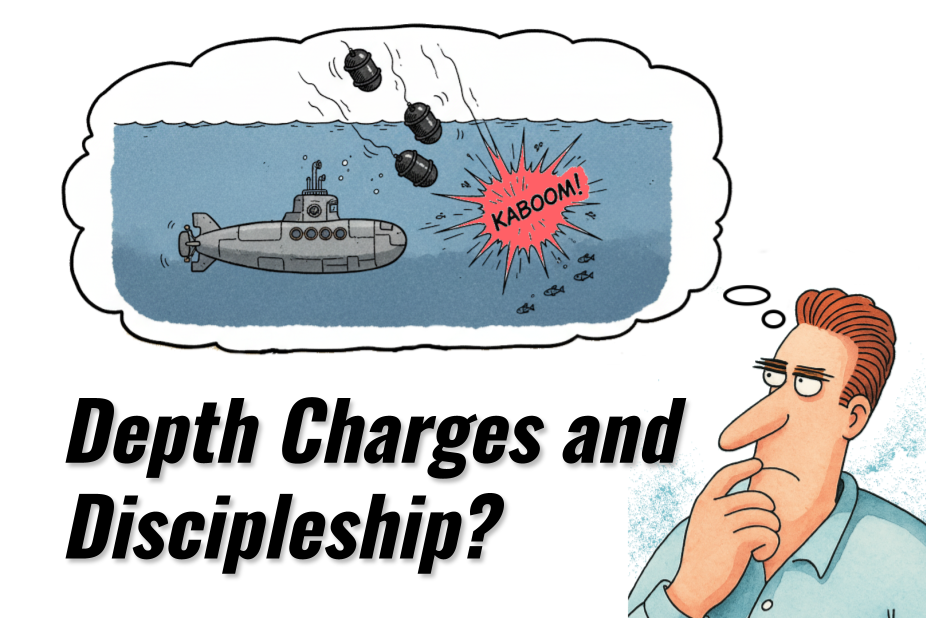
Depth Charges in WWII Anti-Submarine Warfare
Depth charges were the primary anti-submarine weapon of World War II, undergoing significant tactical evolution throughout the conflict while presenting unique challenges in confirming their effectiveness.
At the war’s outset, Allied navies relied on basic barrel-shaped depth charges rolled off the stern of escort vessels. These contained 200-300 pounds of explosive set to detonate at predetermined depths. Early tactics were crude—ships would drop charges where a U-boat had last been detected, hoping for a lucky hit within the weapon’s roughly 20-foot lethal radius. The Battle of the Atlantic, however, drove rapid tactical and technological improvements that transformed these weapons from relatively ineffective to submarine killers.
Ships began dropping patterns of multiple charges to saturate an area, dramatically increasing hit probability. The innovative “creeping attack” emerged, where one ship held sonar contact while another crept in slowly to attack, preventing U-boats from hearing the approach. Forward-throwing weapons like the Hedgehog (1942) and Squid (1943) represented major advances, firing projectiles ahead of the ship to maintain continuous sonar contact during attack. These contact-fuzed weapons only exploded upon hitting a submarine, reducing false alarms. Depth settings also improved as U-boats learned to dive deeper; by war’s end, charges could reach 500+ feet. Long-range patrol aircraft became increasingly important after 1943, dropping depth charges on surfaced or shallow-running U-boats with devastating effect once the Atlantic “air gap” closed.
Confirming a U-boat kill, however, remained notoriously difficult throughout the war. The most convincing proof was physical evidence surfacing after an attack—oil slicks, hull fragments, wooden fittings, clothing, or personal effects. Large oil patches spreading over time were particularly persuasive, though clever U-boat commanders sometimes released oil and debris deliberately to fake their destruction while escaping.
Sonar operators listened for the distinctive sounds of a submarine breaking up—hull collapse, bulkheads failing, or internal explosions. If a previously active submarine suddenly went silent with no further contact despite extensive searching, crews claimed a “probable” kill. This uncertainty was deeply frustrating for crews who might spend hours in brutal attacks without knowing if they’d succeeded.
The difficulty in confirmation led to widespread overclaiming. Allied navies classified results as “confirmed,” “probable,” or “possible” kills, but actual success rates were often far lower than reported. Early in the war, it sometimes took over 100 depth charges per U-boat actually sunk. Intelligence from decoded German communications occasionally provided confirmation when U-boats failed to report in, but this couldn’t be shared with crews for security reasons.
Many wartime claims were only verified years later by comparing Allied attack records with German U-boat loss records. Despite these challenges, improved tactics, technology, and training transformed depth charges into effective weapons by 1943-44, contributing decisively to the defeat of the U-boat threat and Allied victory in the Battle of the Atlantic.
Depth Charges and Discipleship: Generational Assessment
The challenge facing World War II naval commanders dropping depth charges into uncertain waters mirrors a contemporary challenge in disciple-making: how does a first generation disciple-maker accurately assess what is happening at multiple levels below them? In both cases, information must travel through layers—whether ocean depths or spiritual generations—and what surfaces determines understanding and action.
When Allied warships dropped depth charges against U-boats, they sent destructive force through multiple depth layers, waiting for evidence to surface that confirmed success. Sonar operators at various positions reported what they heard, lookouts scanned for debris, and commanders pieced together fragmentary information to assess whether they had achieved their objective. The uncertainty was maddening. Oil slicks might indicate a kill or a clever deception. Breaking-up noises heard at one depth might not be detected at another. Each level of observation contributed partial knowledge, but only the commander integrating all reports could attempt to see the complete picture.
Discipleship faces a parallel dynamic, but with an essential difference: the purpose is constructive rather than destructive. When a primary disciple-maker seeks to assess the health and progress of discipleship spanning multiple generations, they face the same challenge of penetrating multiple “depths” of leadership. Just as depth charges had to reach through layers of water to their target, assessment questions must travel through generations of disciple-makers—from the first generation disciple-maker, through second-generation disciples, to third-generation and beyond. Each generation represents a spiritual depth in the multiplication chain.
The critical parallel lies in responsibility at each level. Just as naval crews had to accurately report what they observed at their position—sonar contacts, visual confirmation, acoustic evidence—each disciple-maker must faithfully transmit information both up and down through the assessment system. An intentional process can serve as the modern equivalent of sonar, providing the mechanism for information flow, but it only functions effectively if each generation faithfully pushes data upstream to leadership and downstream to those they disciple. The primary disciple-maker at the beginning of the stream, like a naval commander, sees the complete picture aggregated from all depths, but depends entirely on the timeliness, integrity, and accuracy of feedback at each intermediate level.
Where depth charges brought destruction, discipleship assessment must bring construction. The goal is not to destroy but to build up the body of Christ—identifying where discipleship is thriving, where it needs support, where spiritual “pressure” exists in the form of challenges or needs at various depths. The information that surfaces through an intentional process should reveal spiritual vitality, multiplication patterns, obstacles to growth, and opportunities for encouragement. When a third-generation disciple-maker reports struggles, and that information travels faithfully through the second generation to the first generation disciple-maker, the response should be resources, prayer, and support flowing back down through the same channels.
The dangers, however, echo those faced by WWII crews. Communication can break down. Information can be filtered by fear or pride at intermediate levels. Just as some U-boat commanders released fake debris to deceive pursuers, disciple-makers might report inflated success to please leadership above them especially if they perceive their salaries or resources are contingent on their performance. Conversely, they might suppress troubling information to avoid appearing unsuccessful. The intentional process of gathering information provides the mechanism, but cannot guarantee transparency.
This is where the comparison reveals its most important lesson: multiple verification points proved essential in naval warfare, and they remain essential in discipleship assessment. The first generation disciple-maker cannot rely solely on what bubbles up through official channels. They need direct relationships, periodic face-to-face contact, and cultural norms that reward honest reporting over optimistic fiction. Just as naval intelligence eventually compared attack reports with intercepted enemy communications to verify kills, wise primary leaders create feedback loops—visiting downstream generations, encouraging peer-to-peer communication, and modeling vulnerability about their own challenges.
The ultimate goal transforms the comparison entirely. Depth charges succeeded when they destroyed their target. Discipleship assessment succeeds when it strengthens every generation of disciple-makers—when the first generation disciple-maker gains accurate understanding, when intermediate generations feel supported rather than merely monitored, and when the newest disciples at the deepest levels know their reality matters to leadership even though they may never meet face-to-face. The intentional process of assessment downstream becomes not a weapon sent into the depths, but a lifeline connecting generations, ensuring that assessment remains constructive, that information flows freely in both directions, and that the entire generational chain grows stronger through transparent, faithful communication across every spiritual generation.
Biblical Examples
Jesus established the pattern of commissioning disciples, sending them into ministry, and receiving their reports. In Matthew 10 and Luke 9, He focused on the Twelve, giving them authority and specific instructions before sending them out, then gathering them afterward to hear what had happened. Later, in Luke 10, He expanded this approach by sending seventy-two disciples in pairs, who returned with joy to report that even demons submitted to them in His name (Luke 10:17). Jesus didn’t send His disciples into the harvest and abandon them to figure things out alone—He created a rhythm of sending, assessing, and responding. His prayer in John 17 reveals the generational scope of His vision: He prayed not only for the disciples He had personally trained, but also “for those who will believe in me through their message” (John 17:20)—acknowledging multiple spiritual generations flowing from His original investment. His final commission made this generational multiplication explicit: “Go and make disciples of all nations...teaching them to obey everything I have commanded you” (Matthew 28:19-20), which necessarily includes the command itself to make disciples, creating an unbroken chain until He returns.
Paul replicated this same pattern throughout his apostolic ministry, maintaining active assessment across the churches and leaders he had established. He regularly sent co-workers like Timothy, Titus, and Epaphroditus to assess situations and report back (Philippians 2:19-30; 2 Corinthians 8:16-24), while also receiving reports from church members about both encouraging developments and troubling conduct. The Corinthian correspondence reveals this dynamic clearly—Paul responds to oral reports from “Chloe’s household” (1 Corinthians 1:11) and written questions from the church, addressing specific issues at multiple depths of their community life. He didn’t wait for problems to surface accidentally; he intentionally created channels for information to flow.
Moreover, Paul trained those he mentored to practice the same assessment principles in their own spheres of leadership. He instructed Timothy to carefully evaluate potential elders (1 Timothy 3:1-7; 5:22), to assess the effectiveness of different workers (2 Timothy 2:2—”entrust to reliable people who will also be qualified to teach others”), and to pay attention to how teaching was being received and applied (2 Timothy 2:14-19). To Titus, he gave similar directives about appointing elders in every town and addressing false teaching that was disrupting “whole households” (Titus 1:5-11), requiring Titus to assess not just individual leaders but the ripple effects of their influence through family and community networks. Both Jesus and Paul understood that faithful multiplication required more than initial training—it demanded ongoing assessment, honest reporting, and responsive care across every generation of disciple-makers.
Potential Application
5 Step Process:
Identify & List: Identify and list your top ten discipleship elements
Select & Ask: Choose one discipleship element and ask one of the people you are discipling the associated question during your regular meeting
Engage & Equip: Listen, encourage, and coach based on what you hear—then ask them to do the same with someone they’re discipling
Surface & Synthesize: Each generation reports key insights upstream in their next meeting (2-3 sentences max)
Pray & Respond: Disciple-makers up and down the chain review, pray, send encouragement/resources back downstream
Key Suggestions for Implementation:
Make it Conversational, Not Clinical:
Embed the question naturally in existing discipleship meetings—don’t create a separate “assessment meeting”
Frame it as “I’m curious about...” rather than “I need to assess...”
The question should spark genuine conversation, not data collection
Simplify Information Flow:
Each person only passes upstream: (1) their own answer, (2) one memorable insight from downstream
Avoid lengthy reports—think “headline + story” not “comprehensive analysis”
Use voice messages or quick texts between meetings if something significant surfaces
Rotate Elements Organically:
Establish regular rhythms (e.g., “Love God” one week, “Prayer” in another)
Let the first generation disciple-maker choose the next element based on what surfaced in the previous cycle
This makes it responsive rather than mechanical
Build in Multiple Verification:
First generation disciple-maker periodically asks the same question directly to 2nd or 3rd generation disciples perhaps in a 1-3-9 meeting (bypassing layers)
Compare: Does what they say match what was reported upstream?
These relational meetings filters information without creating surveillance culture
Create Psychological Safety:
Explicitly celebrate “I’m struggling with...” reports more than “Everything’s great!” reports
Share your own struggles first before asking downstream
If salaries or resources are involved, expect it to muddy the waters in your assessment
Additional Pitfalls to Avoid:
Going too deep too fast - Start with just 2-3 generations until the rhythm is established
Forgetting to close the loop - If someone shares a struggle and never hears back, trust evaporates
Making it one-directional - Downstream generations should also ask the first generation disciple-maker the same questions periodically
Losing the “why” - Regularly remind everyone: “We do this to strengthen each other, not monitor each other”
Collecting without connecting - Information without relationship breeds cynicism
The Simplest Version:
One question → One conversation → One insight upstream → One response downstream → Repeat when natural
The power isn’t in the system’s complexity—it’s in the consistency of care it reveals.
Example - First Generation Disciple-Maker’s Assessment Notes
Discipleship Element: The Word
Question: “What are your rhythms in getting in the Word of God?”
Date: September 30, 2025
Stream: John (me) → Marcus → Al → David
Generation 1 (John - Me)
My own answer first:
Morning coffee + OT/Gospel/NT (one chapter each) - consistent 7 days a week
Struggling with depth - Sometimes I’m on autopilot and don’t get much from my reading
Need to spend some concerted time in Bible study (2-3 hours a week)
Generation 2 (Marcus)
What I heard from Marcus:
Reading through Matthew right now, 15-20 min during lunch break at work
Uses audio Bible during commute (30 min)
Said he’s feels like he’s getting plenty of time in the Word
What Marcus reported from downstream:
Al mentioned he’s all over the place with it
Generation 3 (Al)
What Marcus heard from Al:
Tries to read before bed but often too exhausted
Sometimes goes 3-4 days without opening his Bible
When he does read, it’s “just a verse or two from a devotional app”
What Al reported from downstream:
David is actually doing better than he is—reading with his roommate
Generation 4 (David)
What Al heard from David:
New believer (8 months), reading through John with his roommate Jake (also new believer)
They meet 3x/week at breakfast, read a chapter, talk about what confuses them
Misses days when his roommate travels for work but loves discovering new things
Observations & Patterns
Strengths:
David has built-in accountability and freshness of a new believer
Marcus has multiple touchpoints (visual + audio)
Everyone has some rhythm, even if inconsistent
Challenges:
Al is isolated in his struggle—very little accountability
Marcus and I both sense we’re going through motions (mature believer drift)
Weekend gaps, bedtime struggles for Al, travel disruptions for David
Surprises:
The newest believer has the most joy and consistency
The “problem” isn’t lack of discipline—it’s lack of engagement/freshness (me & Marcus) or sustainable structure (Al)
Prayer & Response Plan
Prayer Focus:
Al: Needs encouragement and accountability. Pray and suggest integrating into a morning routine.
Marcus: Pray for renewed hunger, not just habit.
David: Protect his enthusiasm, help him build depth and daily consistency.
Me: Ask God to break through my mechanical approach and draw some folks into a deeper Bible study.
Downstream Encouragement:
To Marcus: “Thanks for your honesty about ‘checking the box.’ I’m feeling that too. What if we both tried asking God one question each week: ‘What do You want me to see that I’m missing?’ Let’s ask each other what we are getting out of the Word when we meet.”
Marcus to Al: “Tell Al I’m proud he was honest about his struggle. Ask if he’d be willing to try something: read one chapter a day beginning in the Gospel of Mark for the next 16 days in the morning with coffee instead of at bedtime. In 16 days you’ll have finish your first book in the Bible. A quick win!”
Al to David: “Tell David his question about him and his buddy reading together made my day. His hunger is a gift. Encourage him to write down his questions as he reads—they’re gold. Maybe Al could meet with him and Jake once to answer some of those questions? That might help both of them.”